Posted on
The tragedy of AI is that nobody set out to overspend.
They were told, in a magnificent deck, that AI would empower the organisation and their workforce. The workforce has, in fairness, been empowered.
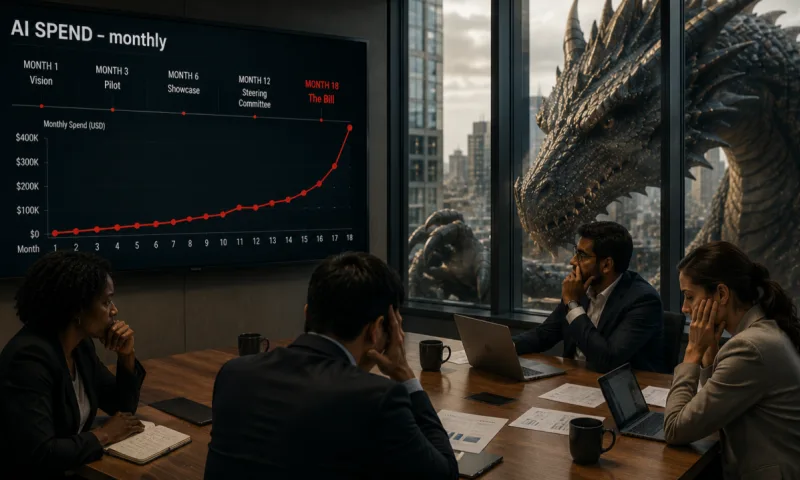
The workforce is now empowered enough to generate $400,000 monthly bills writing slightly improved internal emails.
So, around eighteen months into every AI journey, there is a meeting.
It is convened by the CFO. It is short. There are no biscuits. The people who usually bring the biscuits have sensed what the meeting is about and called in sick.
The meeting concerns the bill.
The bill is, to use the technical finance term, absolutely enormous. It is so large it has its own slide. The slide has been formatted in red, which is a colour choice that required no discussion. Somewhere in the building, an AI agent that nobody remembers commissioning has been running continuously since February, calling itself in a loop, billing by the token, achieving nothing measurable, and generating what the FinOps team will later describe in the post-mortem as "a fascinating cost signature."
An intern, when asked, will mention the dragon.
This is the common AI journey, rendered faithfully:
- Month One, a visionary announcement.
- Month Three, a pilot.
- Month Six, a showcase in which the demo works beautifully on data that has been quietly hand-cleaned by two engineers who have not slept properly since April.
- Month Twelve, a steering committee that has stopped asking hard questions.
- Month Eighteen, the bill.
- Month Eighteen plus two weeks, the executive who announced the transformation updates their LinkedIn to say they are "excited to share a new chapter." The post gets forty-seven likes. Fourteen of them are from vendors.
- Month Twenty-Four: a new executive arrives and announces a new AI strategy. The old one is not discussed. The biscuits are back.
A February 2026 survey of 500 finance leaders found 89% of mature FinOps organisations had AI cost overruns in the previous year. Mean overspend: 30.9%. Organisations now routinely overspend on AI workloads by four to five times their original budget, according to the State of FinOps 2026. IDC forecasts a further 30% rise in underestimated AI infrastructure costs by 2027, which is IDC's way of saying "you think this is bad."
The natural response to all of this is to cut. Issue a stern memo. Freeze the pilots. Cancel the vendor contract with the magnificent deck. Punish the dragon financially, insofar as a dragon can be financially punished.
This response is deeply intuitive and, according to Gartner research, almost entirely useless. Fewer than half of organisations hit their cost-cutting targets in year one. Only 11% sustain those cuts over three years. And, this is the number worth reading twice, only 9% of organisations say they can maintain their pace of innovation after the cuts land.
Nine percent.
The CFO is satisfied. The board is satisfied. The engineers who understood how the AI actually worked have, sensing what was coming, updated their own LinkedIns. They have not mentioned the dragon.
What the other 91% discover, somewhere around Month Thirty, is that they have not cut costs. They have cut capability, morale, and the two or three people who knew which agent was doing what, and why it cost that much, and how to make it cost less without breaking it. What they have preserved, with great care, is the spreadsheet. The spreadsheet remains. The spreadsheet has always remained. The spreadsheet is fine.
The distinction that matters is between cost-cutting and cost optimisation. Cost-cutting is a number going down on a slide. Cost optimisation is a continuous practice of reducing what things cost to deliver while keeping, or improving, what they actually deliver. One of these requires a memo and a difficult town hall. The other requires governance, visibility, accountability, and someone whose job it is to notice the dragon before February.
The organisations building durable AI programmes are not spending less. They are spending with their eyes open. Token budgets enforced in real time. Cost attributed to the team and workflow that generated it. Cheaper models doing simple tasks. Expensive models reserved for the work that justifies them. A FinOps practice that treats AI spend like any other operational cost, with owners, thresholds, and a standing agenda item that does not get bumped for the quarterly business review.
This is, admittedly, less exciting than announcing a transformation. There is no town hall. Nobody gets a new title. The LinkedIn post, if it exists at all, gets four likes, two of which are from the same vendor.
What it produces, instead, is the thing most AI programmes do not have by Month Eighteen: a cost model the CFO can read without reaching for the red palette.
And a policy about the dragon.
Every organisation, eventually, needs to govern well, and have a policy about the dragon.