Posted on
It is a truth universally unacknowledged that the most critical role in many organisations is not the Chief Executive, the CFO, the CIO, the CTO, or more, even the newly appointed Chief Transformation Officer.
It is the person who orders the biscuits (cookies).
Not metaphorically.
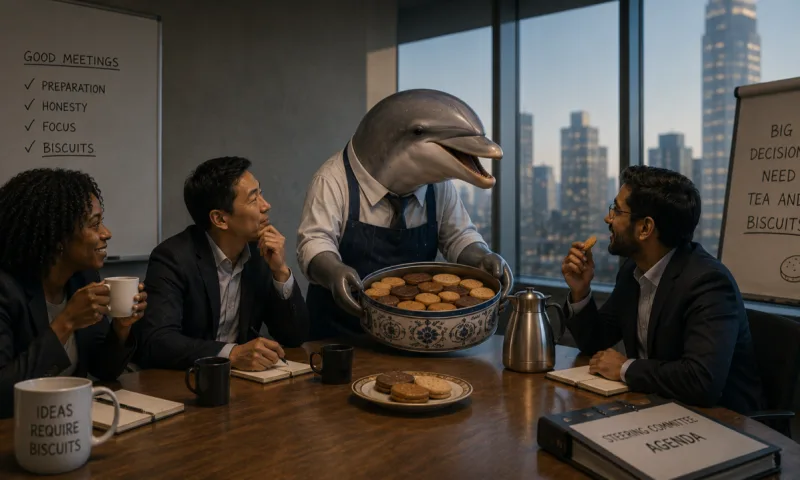
The person who, with quiet competence, with no specific entry in the org chart, ensures that when up to twelve people sit down to make a decision that will affect the livelihoods of several hundred others, there is something on the table that makes the room feel, against all evidence, like things are going to be fine.
The Biscuit Operator.
We do not speak of them at town halls. They do not present at All Hands. Their name does not appear on the vendor contracts, the steering committee minutes, or the slide marked "Key Stakeholders." They appear, instead, at 8:47am on a Tuesday, carrying a tin, and the room, unconsciously, instinctively, in the way that mammals respond to warmth, relaxes.
History, if it were written honestly, would credit them more.
Often it is the unarchitected backbone of organisational civilisation.
A Brief and Selective History of Biscuits at Critical Moments
Coffeehouses, Teahouses and Biscuits
The coffeehouse culture of seventeenth century London, without which, and historians are fairly clear on this point, the Enlightenment proceeds considerably more slowly. The coffeehouses of the 1650s and 1660s were not merely places to drink something bitter and argue about philosophy. They were, functionally, the internet of their day: places where merchants, scientists, poets, politicians, and the merely curious gathered, sat down together, and exchanged information across social classes in a way that almost nowhere else permitted.
Lloyd’s of London began as a coffeehouse.
The London Stock Exchange began as a coffeehouse.
The Royal Society, the oldest national scientific academy in continuous existence, held its early meetings in coffeehouses. Isaac Newton was a known frequenter. Christopher Wren attended. Robert Hooke, who discovered the cell, who laid the groundwork for the theory of elasticity, who was by any fair reckoning one of the most productive scientists in history, is reported to have visited the same coffeehouse, Garraway’s, in Exchange Alley, so consistently that it served as his de facto office.
None of this, it should be noted, was happening around a whiteboard. It was happening around a cup of something hot and, almost certainly, something to eat alongside it. The biscuit, or its ancestors, was present at the birth of modern science. This is not a coincidence. This is how ideas work. Ideas require a reason to stay in the room long enough for the conversation to go somewhere unexpected. The drink provides the reason. The biscuit provides the twenty additional minutes.
3M notes
Consider, closer to the present, the invention of the Post-it Note. Spencer Silver at 3M synthesised a low-tack adhesive in 1968 that he couldn’t find a use for. Art Fry, a colleague, was singing in a church choir and frustrated that his bookmark kept falling out of his hymnal. The two men, over some years of casual conversation, the kind of conversation that requires proximity, comfort, and no particular agenda, arrived at the Post-it Note. The product launched in 1980. It is now, by most estimates, one of the most ubiquitous objects in the modern office.
3M’s internal culture at the time is well documented: scientists were given 15% of their time to pursue speculative ideas. A precursor of sorts to Google’s 20% projects. They were also, by multiple accounts, well provisioned. The 3M campus was not a place that left people hungry and in a hurry. The creative conversation between Silver and Fry did not happen under pressure. It happened in the margin, over time, in the kind of environment that a biscuit, metaphorically and perhaps literally, helps create.
One final example: the entirety of the British Empire.
Whatever one’s views on the British Empire, and they are various, and many of them correct, it administered itself, at its operational peak, across roughly a quarter of the Earth’s surface, through a civil service that ran on tea with a dedication that has never been equalled in the history of hot beverages. The afternoon tea break was not a nicety. It was load-bearing infrastructure. Remove it and the whole thing wobbles. The biscuit, in this context, was not a snack. It was a scheduling mechanism, a social contract, and a reason to stop shouting at each other for fifteen minutes.
The digestive biscuit, developed in 1892 and so named because it was thought, incorrectly, but optimistically, to aid digestion, became the most consumed biscuit in the United Kingdom, a country that takes biscuit consumption with a seriousness that would be considered excessive if applied to almost anything else. The specific biscuit architecture of a meeting, Rich Tea versus Hobnob versus Bourbon versus, in a clear signal that something important is being decided, the chocolate digestive, carries social information that no org chart captures but every participant reads fluently.
- A plate of Rich Teas says: this is a routine matter. We expect no drama.
- A plate of Hobnobs says: this will take longer than advertised. Pace yourself.
- A plate of chocolate digestives says: someone has been told this meeting is important. Behave accordingly.
- A plate containing a Jaffa Cake says: there is disagreement at the senior level about what constitutes a biscuit, and it has not been resolved.
The Biscuit Operator Today
In 2026, many organisations have automated their procurement. The biscuits, in some buildings, are ordered by an algorithm that analyses consumption patterns, adjusts for headcount fluctuations, and optimises the tin’s contents for nutritional balance and cost efficiency. The algorithm has never been in a meeting. The algorithm does not know what a chocolate digestive signals. The algorithm, if asked to make the call on a Monday morning with a difficult conversation scheduled for eleven, will order Rich Teas, because Rich Teas are the median preference, and the algorithm is not paid to read a room.
The human Biscuit Operator knows.
They know because they have been reading the room, without being asked, for longer than most of the steering committee has been employed. They know that the eleven o’clock meeting needs Hobnobs because it is going to run long, and probably a plate of something with chocolate on it because two of the attendees are going to be difficult and chocolate is cheaper than therapy.
The best organisations, and there is research on this, buried inside decades of organisational psychology under terms like "psychological safety" and "ambient belonging cues", are the ones where the small signals of care are consistently present. Where the room feels, against the available evidence, like someone thought about it before you got there. Where the table is set not for the meeting as it appears on the agenda but for the meeting as it is likely to actually unfold.
The biscuit is that signal, made edible.
Gartner, in its work on organisational culture, has noted for years that high-performing teams share a common characteristic: members feel that the environment is designed with them in mind. Not in the grand strategic sense, but in the daily operational sense. The coffee is good. The room is comfortable. There is something on the table. These are not luxuries. They are, in their small way, the conditions under which people are willing to stay in the room long enough to get something done.
The Enlightenment happened.
The Post-it Note was invented.
The British Empire filed its paperwork.
All of it, in one way or another, over something warm and something to go with it.
The biscuit operator did not get a footnote in any of this. They should have. They should have several.
In the meantime, if yours is good at their job, tell them. The next steering committee will go better than you expect, and you will not entirely be able to explain why.