Posted on
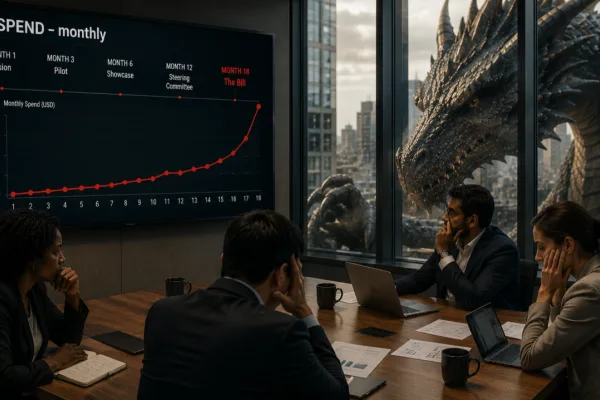
If you're a CIO, a CFO, a program sponsor, or a board member putting your name to the investment case, you know this pattern from the inside: The business case is written. The vendor's keen to start. The implementation partner has pencilled in a date before anyone's finished testing whether the plan is actually right. And you're the one who has to sign it anyway, because stopping now costs more, on paper, than being wrong later.
So now you have timelines set before the scope was settled. A vendor roadmap that's quietly become your roadmap. A preferred supplier that keeps surviving the evaluation no matter who else is shortlisted. A room full of people with a stake in the answer, and not enough people whose only stake is whether it's right.
It doesn't matter whether you're running a federal department, a state agency, or an ASX-listed company answering to a board and a market. The pressure is identical: make faster calls on AI, cloud, cybersecurity, data and modernisation than you've ever had to before, with more budget and more of your own name attached to each one.
And the people you'd normally lean on to sanity-check those calls have had a rough few years. More than one firm that was supposed to be an independent adviser turned out to be selling into the same organisation it was meant to be scrutinising, or moving information between clients who should never have been in the same room.
Treasury's own consultation into the sector, open until 12 August 2026, is proposing real change off the back of it, closer ASIC oversight, larger penalties, and term limits for firms that currently only rotate individual partners every five years. One of the larger players has already agreed not to bid for new federal work while it sorts its governance out. We know some of the folks in the companies, good people, impacted by the actions of a few.
So the question isn't really "is this the right technology." It's:
"Who's actually checking the approach and choices for me, and, what do they get if I say yes."
That's the gap we sit in.
We don't sell cloud platforms, AI products, or implementation.
There's no quota behind our advice, which means when we tell you something isn't ready, isn't needed, or has been shaped to suit someone else's roadmap more than yours, that's all it is: an assessment with nothing riding on which way it goes other than your success.
That's the whole premise behind Transformation Assurance. It sits inside the decision while it's still live, rather than auditing it after the fact (although we can if needed), and it's built to catch what a vendor pitch never mentions:
- A policy or compliance commitment made before the business case can survive scrutiny
- A procurement quietly shaped around a preferred bidder rather than the best outcome
- A technology commitment locked in before the strategy it's meant to serve is settled
- Supplier performance that erodes quietly once the contract's signed and attention moves on
- AI tools spreading team by team, department by department, with nobody owning the whole picture
- Platform dependencies nobody mapped until leaving became the expensive option
Gartner's most recent survey of government CIOs found the same instinct taking hold well beyond Australia. Its a real shift toward spreading risk across providers instead of betting everything on one, driven less by cost than by exposure.
Commentary on AI procurement out of the US federal sector puts the stakes more bluntly:
The platform decisions being locked in this year will shape what's possible for a decade, much like the last wave of cloud contracts did, except the scale this time is larger, and the exit harder.
None of this is complicated. It's just been easy to overlook while everyone in the room advising you also had something to sell you.
Whether you answer to a minister, a board, or a market... independence isn't the comfortable option. It's the only thing that lets your decision still make sense three years after everyone who sold it to you has moved on.