Posted on
In February 2026, Forrester analyst Charles Betz published a blog post titled "Enterprise Architecture Has Never Been Stronger."
In the same approximate fortnight, Gartner research noted that 32% of EA deliverables are never reused by anyone, which is a polite way of saying that one diagram in three goes directly from PowerPoint to the void, without troubling a single human decision on the way.
Both findings are, somehow, correct.
They are looking at different rooms.
In one room... let us call it The Room With The Strategy Off-Site... EA is becoming the operating system for AI in the enterprise. There are frameworks. There are mature practices. There is a phrase, "AI-ready architecture," which is currently being nodded at thoughtfully in steering committees by people who are not entirely sure what it means, but who are aware that disagreeing with it in front of the CIO would be a mistake. A consultant is presenting. The consultant is using the word "fabric." It does not mean fabric.
In the other room... let us call it Where The Work Happens... an architect is being asked, for the fourth time this quarter, what the difference is between The Framework is great, and what they actually do, by a product manager who has been told to "include EA in the design process" and is now somewhat reluctantly doing so. The architect is patient. The architect explains. The product manager nods, returns to their team, and proceeds exactly as they were always going to. The architect, not for the first time this month, looks up cabinetry courses on their lunch break.
Both of these are, technically, enterprise architecture in 2026.
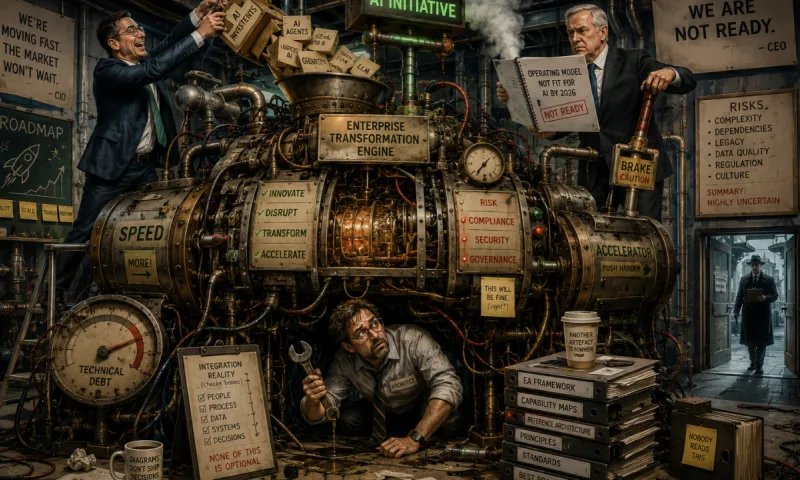
The genuinely funny part is what the numbers show when you put them next to each other. Gartner research, again via Avolution, finds that more than 60% of CEOs admit their operating models aren't fit for AI implementation by the end of 2026. Nearly 60% of CIOs are pushing ahead with enterprise-wide agentic AI deployments anyway.
These are, statistically, the same organisations.
The CEO and the CIO have, presumably, met. They may even, on occasion, eat lunch together. Whether they have ever discussed this specific point is a matter on which the data is silent. What is clear is that somebody in the middle has been quietly asked to make this work, and that somebody is almost certainly an enterprise architect, who is being asked to design the operating model for a transformation the executive doesn't believe will succeed, using tools the engineering teams have already decided not to wait for.
This has always, in fairness, been the job. What's new is the velocity. The gap used to open over years. It now opens in quarters.
There is a further small comedy unfolding in the background. Forrester also notes that AI agents are now embedded in modern EA tools, automating data validation, capability mapping, and artefact creation. Which is to say: the AI is now doing the architecture. Or at least the bits of it that involve typing.
This leaves the question, gently raised at conferences but rarely answered out loud, of what the architects are now meant to be doing. The answer, for the ones who are thriving, turns out to be the part of the job the AI cannot do: noticing the thing nobody else has noticed, and saying it out loud in a meeting, before the budget has been committed.
This is, awkwardly, the part that was never in the framework.
So Forrester is not wrong that EA is having a moment. AI introduces probabilistic behaviour, opaque reasoning, and non-linear failure modes into systems that were already, in most cases, only nominally understood. The architect is the only person in the building paid to think about how all of it connects, which becomes valuable at precisely the moment the regulator turns up. And they will, on 2 August, with a clipboard and a list of questions about your high-risk AI inventory.
And Gartner is not wrong that a third of what EA produces goes straight into a folder nobody opens. Some of those folders, by mid-2026, have "AI" in their file names. None of them, by mid-2026, are being read by anyone, including, ironically, the AI.
The trick, which a small but growing number of organisations are starting to get right, is to stop confusing the output of architecture with the work of it. The output is a diagram. The work is a decision somebody now has to make differently because the architect pointed something octs are now meant to be doing. The answer, for the ones who are thriving, turns out to be the part of the job the AI cannot do: noticing the thing nobody else has noticed, and saying it out loud in a meeting, before the budget has been committed.
This is, awkwardly, the part that was never in the framework.
So Forrester is not wrong that EA is having a moment. AI introduces probabilistic behaviour, opaque reasoning, and non-linear failure modes into systems that were already, in most cases, only nominally understood. The architect is the only person in the building paid to think about how all of it connects, which becomes valuable at precisely the moment the regulator turns up. And they will, on 2 August, with a clipboard and a list of questions about your high-risk AI inventory.
And Gartner is not wrong that a third of what EA produces goes straight into a folder nobody opens. Some of those folders, by mid-2026, have "AI" in their file names. None of them, by mid-2026, are being read by anyone, including, ironically, the AI.
The trick, which a small but growing number of organisations are starting to get right, is to stop confusing the output of architecture with the work of it. The output is a diagram. The work is a decision somebody now has to make differently because the architect pointed something out before everyone else noticed.
The first is measured in artefacts. The second is measured in how loudly the room goes quiet when you stop attending.
If your EA function disappeared tomorrow, would the business notice within a week?
The honest answer, in most organisations, is "...eventually, around the third audit."
The work of the next two years, for anyone with "architect" in their title, is to make that answer less embarrassing.
Cabinetry is, by the way, a perfectly respectable profession. It involves real materials, has measurable outcomes, and almost never requires a steering committee.
But the EA job, done properly, can be a more interesting one. It is also the one the regulator is about to needs... urgently.