Posted on
...and where it often fails.
It’s one thing to build an AI pilot.
It’s another to make people, process and data work in a way that delivers business value.
We hear this a lot from clients who are past the “can we build something?” phase.
Many have survived the engineering hurdles.
Where they stall is in organisational alignment.
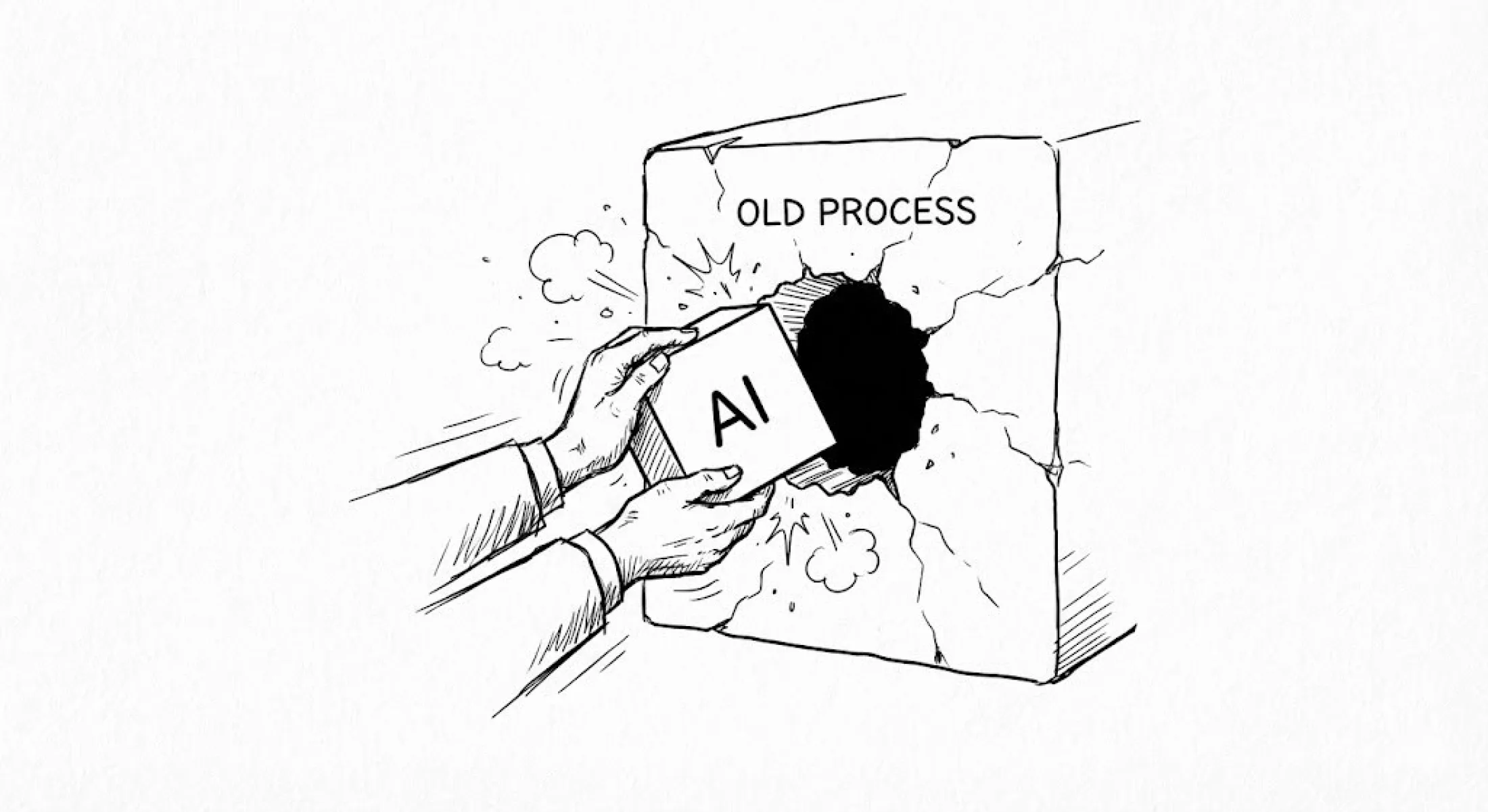
Not because teams aren’t trying, but because AI interacts with work, governance, risk and decision-making, not just code and compute. So organisations end up trying to retro fit AI into old, creaky processes, thinking they're optimising, but often creating more cracks and issues than before.
Analysts paint a clear picture of the challenge that’s been consistent over the last couple years:
- Organisations that see measurable AI value are far more likely to redesign workflows rather than just bolt AI onto existing processes. High performers are nearly three times more likely than others to say they have fundamentally redesigned individual workflows around AI capabilities. (McKinsey State of AI Nov 2025)
- Fewer than one-third of decision-makers can tie AI initiatives to measurable financial impact, even as adoption grows. Similarly, effective integration and business alignment are the key barriers preventing pilots from delivering enterprise value. (Forrester’s Predictions 2026)
- While 75% of enterprises are piloting or deploying AI agents, concerns around governance, maturity and agent sprawl are slowing the progression to scaled, integrated deployments that deliver consistent business outcomes. (Gartner 2026)
- While most organisations report using AI in at least one function, most are still in early phases of adoption, with deep integration and value realisation lagging far behind surface experimentation. (McKinsey, State of AI, Nov 2025)
AI success isn’t about hype. It’s about organisational design.
A primary barrier to scaling AI value today isn't technological immaturity, but organisational inertia to process change.
Why People and Process Matter More Now Than Ever
Two systemic issues show up… again and again:
- Work isn’t reimagined, it’s just automated: Too often AI is inserted into existing workflows in ways that optimise task execution but don’t change decision flows, accountability, or collaboration patterns. That may deliver a speed bump but not strategic lift.
- Teams don’t adapt roles or skills to match AI’s impact: AI changes who does what and how value is created. If people are not part of that redesign, that is if humans are simply expected to “manage exceptions”, friction builds rapidly and expected ROI evaporates.
It’s the exceptions that cost you!
These dynamics align with the research, showing that AI ROI is tied not to model quality alone but to organisational readiness and process redesign, yet most organisations remain in a pattern of sprinkling AI on top of old ways of working.
Gartner forecasts that in 2026, up to 40% of enterprise applications will include task-specific AI agents, up from less than 5% currently, illustrating rapid adoption, but also underscoring the urgency of embedding these technologies into controlled, outcome-oriented processes. (Gartner)
People and Process in Practice: A Real Example
A recent engagement of ours illustrates this well. The client came to us with a transformation roadmap focused on technology, new tools, new systems, new dashboards, but without a shared understanding of strategic intent or a way to align work across teams.
Alone, those investments would have amplified fragmentation.
Our approach began by aligning:
- Business strategy and intent (what the organisation must deliver),
- Capability models as the foundation for design, and
- Governance, roles and decision paths that make sense in practice, not just in theory.
The client gained insight and tools to do it right:
- A capability model that explicitly tied execution flows to business outcomes,
- Logical data models that supported consistent decisions,
- Reference architectures that provided clarity on integration boundaries,
- And governance structures with real accountability and escalation paths.
With this alignment in place, redesigning workflows was no longer an abstract “change” initiative. It became a coordinated evolution of how work gets done, who owns what, and how value is measured.
The result? Teams were not only using the right tools they were using them in ways that changed work patterns and improved outcomes.
The Missing Link: Architecture with Agency
Here’s the quiet organisational truth:
Technology changes fast. People and processes change slowly.
If you don’t have an anchor for that change, AI becomes fast automation of broken processes.
That’s why enterprise architecture, solution architecture and more, especially when grounded in capability models, matters.
It is the discipline that holds together:
- Strategy
- Governance
- People and roles
- Workflows and processes
- Data structures
- Technology components
Together these factors determine whether AI amplifies capacity or just accelerates chaos.
Because the real value of AI isn’t in the automation. It’s in transforming how work, decisions and organisational outcomes are created.