Posted on
Every organisation insists it knows where it’s going.
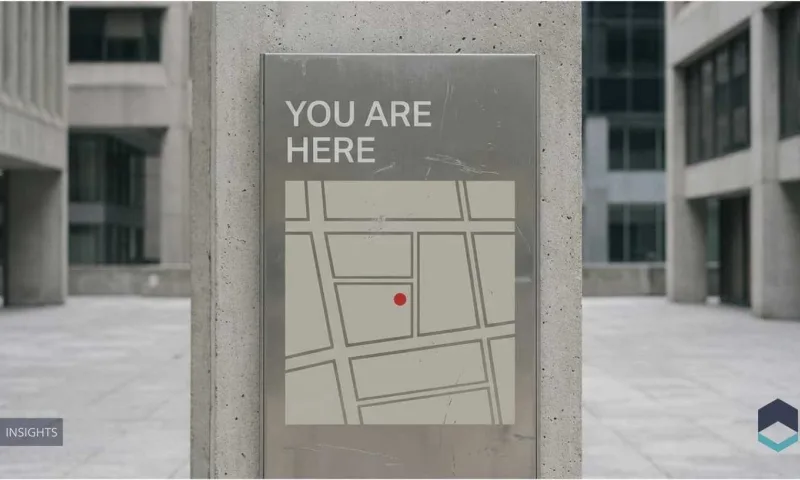
There are maps.
There are districts.
There are signs pointing to “Strategy”, “Delivery”, and “Transformation”.
And yet, if you stand still for long enough, you notice something odd.
People keep asking for directions.
Some teams wander in circles between familiar streets, productive but never quite arriving anywhere new. Others avoid entire neighbourhoods altogether, parts of the organisation that feel unsafe, confusing, or simply not worth the effort to enter anymore.
If an organisation were a city, most of its problems wouldn’t be about ambition. They’d be about wayfinding.
There are intersections with no signage, where decisions have to be made quickly, but nobody is sure which turn is allowed. So traffic slows. People hesitate. Meetings form like roundabouts, keeping everything moving without committing to an exit.
There are shortcuts that only locals know. Informal paths carved through grass where the official roads are too slow or too rigid. These paths work, until the people who know them leave, and suddenly no one understands how anything connects anymore.
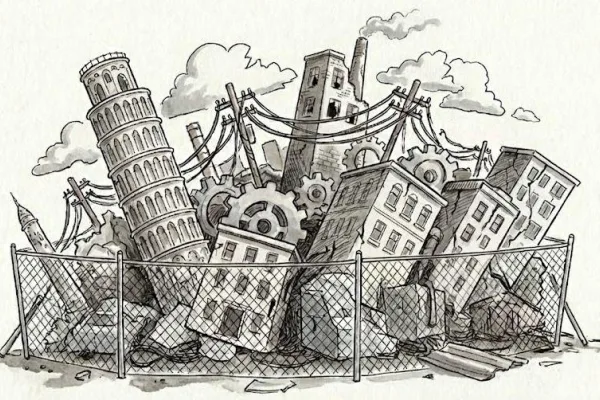
There are districts frozen in time. Systems, processes, and structures built for a city that no longer exists, still standing because tearing them down feels risky. New buildings are constructed around them, awkwardly, bending everything else out of shape.
And then there are the dead ends.
Teams sent down long streets with energy and intent, only to discover the road was never connected to anything meaningful. No feedback loop. No return path. Just a quiet reversal and a reluctance to admit the journey didn’t matter.
The most telling feature of these cities isn’t chaos. It’s politeness.
No one puts up a “Do Not Enter” sign. No one closes a road properly. Everything stays technically accessible, even when it shouldn’t be. The result is congestion everywhere, and clarity nowhere.
Good architecture, in this framing, isn’t about control. It’s urban planning.
It decides which roads matter.
Which intersections need signals.
Which paths should be paved, and which should be blocked entirely.
Most importantly, it makes movement legible. People shouldn’t need tribal knowledge to find their way. Progress shouldn’t depend on who you sit next to or which unwritten rules you’ve learned to respect.
The question isn’t whether your organisation has a map.
It’s whether anyone can actually use it without getting lost.