Posted on
January has a particular energy.
New strategies.
New priorities.
New initiatives with fresh names and sharper slides.
There’s a quiet belief that progress comes from adding something new. A new program. A new platform. A new way of working. As if momentum is created by novelty alone.
But in most organisations, the most important work this year won’t be new at all.
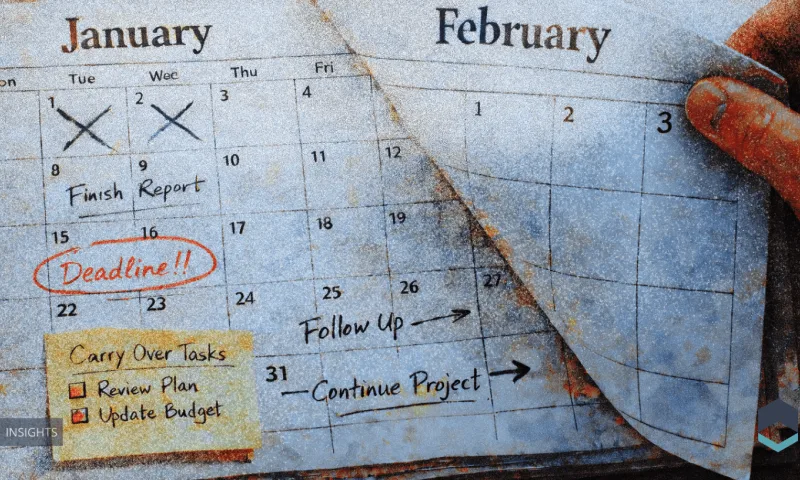
It will be the follow-through.
The work we already agreed to but didn’t finish
Every organisation carries a backlog of decisions that were made with good intent and then slowly starved of attention.
A capability model that informed one planning cycle and then faded.
A governance change that looked sensible but never quite stuck.
A technology decision that assumed behaviour would magically change around it.
None of these failed dramatically. They simply drifted.
This year’s constraint is rarely a lack of ideas. It’s the accumulated weight of unfinished ones.
Why follow-through feels harder than starting
Starting feels productive. It creates visible motion. There’s a dopamine hit in announcing something new.
Follow-through is quieter. Less glamorous. Often more political.
It asks uncomfortable questions:
- Are we actually doing the thing we said mattered?
- Did we resource this properly, or just endorse it conceptually?
- What trade-offs are we now avoiding by pretending this is still “in progress”?
Finishing forces clarity. And clarity removes optionality. That’s why it’s harder.
Legacy isn’t the enemy. Amnesia is.
There’s a tendency at the start of the year to treat the past as something to escape.
New year. Clean slate.
But organisations don’t reset. Context carries forward whether we acknowledge it or not.
The real risk isn’t legacy systems or previous decisions. It’s organisational amnesia. Forgetting why choices were made, what problems they were meant to solve, and what was intentionally left unresolved.
Progress comes from continuity with intent, not reinvention.
The quiet work that actually changes outcomes
The work that matters most this year will likely look like:
- Tightening decision rights that were loosely defined last year
- Re-sequencing priorities rather than adding new ones
- Saying no to “just one more initiative” to protect capacity
- Revisiting assumptions that no longer hold
- Finishing things to the point they actually change behaviour
None of that fits neatly on a launch slide.
But it’s the difference between activity and impact.
A different kind of ambition
There’s nothing wrong with ambition at the start of the year. But ambition doesn’t always mean expansion.
Sometimes it means discipline.
Sometimes it means restraint.
Sometimes it means having the courage to finish what others quietly moved past.
If this year has a theme worth committing to, it might be this:
Not more.
Not faster.
Just done properly.