Posted on
There is a particular silence that descends in a meeting room when someone asks, eleven months into a three-year roadmap, whether the assumptions are still valid. It is the silence of a group of intelligent adults collectively pretending not to have heard the question.
Tea is sipped. Coffee slurped. Soda injested.... A laptop is opened, then closed.
Eventually the chair moves to the next agenda item, and everyone is quietly grateful.
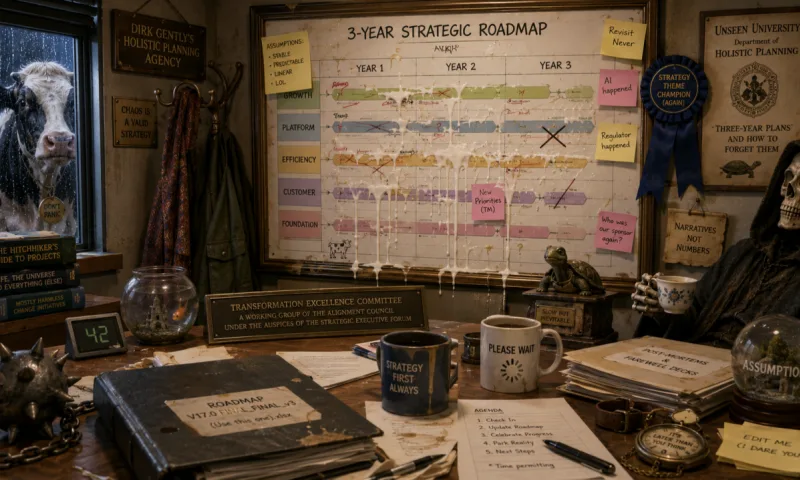
The roadmap is still on the wall. The roadmap is fine. The roadmap is, in fact, beautifully laminated.
This three-year roadmap was approved in January with great ceremony. It had swim lanes. It had a colour palette curated by someone who used the word "deliberate" twice in their email signature. It had a slide titled "Strategic Themes" that no one could explain but everyone agreed sounded important.
By March, generative AI had eaten two of the swim lanes. By June, a regulator had eaten a third. By September, the executive sponsor had moved on to a new role at a competitor, taking the roadmap's only true believer with them. By December, the document was a museum piece, beautifully framed, visited rarely, referenced mostly in post-mortems and farewell speeches.
The remarkable thing is that everyone in the room in January knew, on some level, that this would happen. It happens every year. It happened last year. It will happen next year, with a slightly different colour palette. And yet the ceremony continues, because the alternative, admitting that no one can reliably predict the next three years of anything is felt to be impolite.
What the research says. The numbers here are not encouraging, and have not been for some time. McKinsey's long-running finding is that around 70% of large-scale transformations fail to achieve their objectives. Bain's 2024 study of more than 400 executives put the figure higher: only 12% of business transformations actually achieve their original ambitions. BCG's analysis of more than 850 companies sits in between, at roughly 65–70% falling short of stated goals.
Robert Kaplan's research, most famously cited in The Balanced Scorecard, found that 90% of organisations fail to execute their strategies as planned. A figure that has been more or less stable since the late 1990s. Either the strategies are wrong, or the world keeps moving, or both. The data has never been able to decide which.
So what?
A roadmap is a hypothesis, not a contract. Anyone treating it as a contract is, by Christmas, defending decisions made when the world looked different, usually with a tone that suggests this is somehow the world's fault, and not the roadmap's, and certainly not their own.
The best roadmaps I have seen are deliberately a bit boring. Fewer themes. Shorter horizons. Enough room to be wrong without anyone needing to pretend they weren't. They are written by people who understand that the point is not to predict the future but to decide, soberly, what to do next. And then to do it again in six months, with whatever the world has handed you in the interim.
The roadmap that ages well is the one that expects to be edited. The one in the frame on the wall is, almost by definition, no longer in use.